

Check out the audio podcast version of this post on Apple Podcasts or Spotify.
Are you tired of constantly hitting wrong notes in your solos?
There’s actually one very simple exercise that makes it virtually impossible to play wrong notes when improvising.
In this article (and the video above), I’ll show you exactly what the exercise is and how to practice it so you can nail the chord changes and play solos that sound great.
The Common Problem with How Scales Are Taught
Typically, we’re taught to apply scales to chords in a progression like this:

Each chord shows its corresponding scale, but the way it’s written out can be a bit problematic.
It tends to make beginning improvisers just play the scales up from the first note—the root—every time.
But that’s not what we actually want to do when improvising.
We want to be able to:
- Start scales on any note
- Move in either direction
- Connect chords smoothly across the progression
Another problem with the typical “scale per chord” layout is that it makes us think of each bar as a completely separate thing. In real improvisation, we want to connect the chords seamlessly.
That’s where the Big Scale Exercise comes in.
What Is the Big Scale Exercise?
The Big Scale Exercise trains you to move through a chord progression while:
- Starting on any note of the scale
- Moving up or down
- Switching scales automatically when the chord changes
Once you master it, something powerful happens:
your fingers naturally land on the correct notes with little or no thought.
Instead of worrying about hitting wrong notes, you can focus on phrasing, groove, and musical ideas.
To demonstrate the exercise, we’ll apply it to the chord progression of Blue Bossa.
How the Big Scale Exercise Works
The idea is simple:
You play one continuous scale over the entire progression using a steady stream of eighth notes.
You keep moving up until you reach the top of your range. Then you change direction and move down until you reach the bottom of your range, and then head back up again.
The only rule is this:
Your note choices must match the scale for the current chord.
Here’s what the first four bars of the exercise sound like over Blue Bossa in the video above.
Example: First Two Chords of Blue Bossa (Alto Sax)

For alto sax, the first chord is A-7.
So we’ll use an A Dorian scale.
If I start on A and play steady eighth notes going up for two bars, I’ll reach high F# and then change direction.
When we arrive at bar 3, the chord changes to D-7.
At that point we switch to D Dorian, continuing downward from the note B.
When we reach low B, which is the lowest note in that scale on the saxophone, we change direction and head back up.
Practicing the Exercise Over the Whole Form
We continue like this over the entire chord progression.
When you’re first learning the exercise, it can be very helpful to write the notes down, just like in the example shown here.

Keep in mind that multiple scales can work over the same chord, so you’ll need to decide which scales you want to use before starting.
For this example, I’m using the most obvious scale choices for each chord.
But the Big Scale Exercise is also a great way to practice incorporating different scale sounds into your improvisation.
Experimenting with Different Scales
For example, in bars 11 and 12, you could decide to play B♭ Lydian instead.

Or you might choose to play A melodic minor over all the A minor chords.

Because the exercise continues through multiple choruses, the starting note and direction constantly change.
In the next chorus, for example, you might arrive at the top of the form on E while moving downward, which means every scale begins from a different point.
The goal is to keep looping the form until switching between scales becomes automatic.
Two Things You’ll Notice Immediately
When you start practicing the Big Scale Exercise, two things become obvious right away.
1. There’s No Space to Breathe
Because the exercise is continuous eighth notes, there’s technically no room to breathe.
The solution is simple:
Breathe when you need to, but keep your fingers moving.
2. It Doesn’t Sound Musical
The exercise sounds very mechanical and robotic.
That’s completely normal.
We are not practicing this exercise so we can play endless streams of eighth notes in our solos.
We’re practicing it so we can switch between scales instantly and from any direction.
By training this skill, you start making the correct note adjustments automatically, without thinking.
And when that happens, your brain is free to focus on what actually matters:
- Creativity
- Groove
- Musical expression
Getting to the Next Level
Start with a chord progression you already know and practice the Big Scale Exercise at a comfortable tempo.
Once you can play several choruses easily, here are a few ways to push your playing to the next level.
1. Speed Up the Tempo
Increase the tempo and find your speed limit for playing continuous eighth notes.
Pay close attention to your time feel at different tempos.
And make sure to keep your fingers, hands, and shoulders relaxed as you practice.
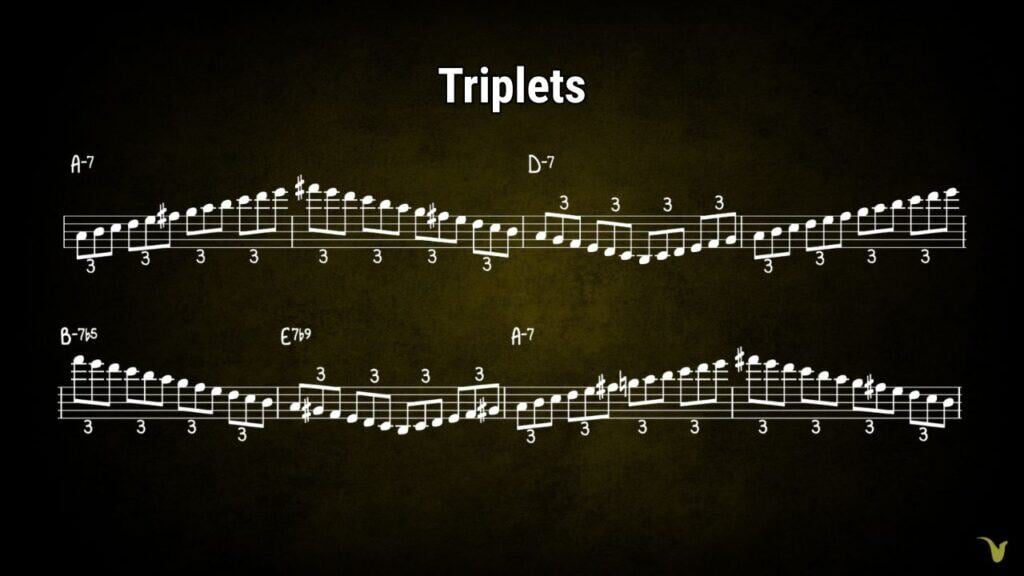
2. Switch to Triplets
Try doing the entire exercise using triplets.
This variation can do wonders for your rhythmic control and feel.
3. Try Double Time
The Big Scale Exercise is also an excellent way to build speed.
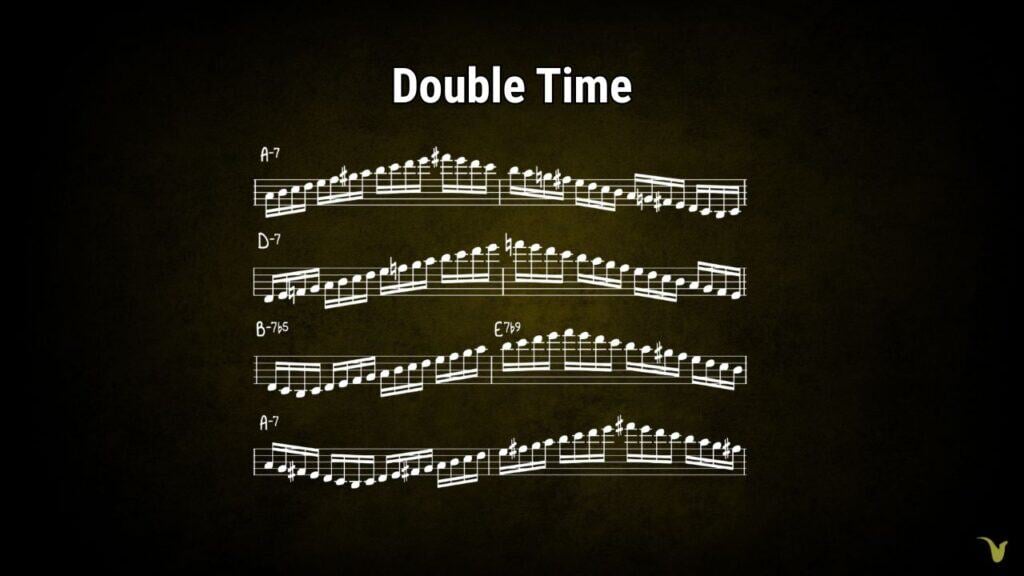
When playing in double time, make sure you adjust your articulation.
Over-articulating can slow you down when you’re trying to play fast.
One More Important Insight
Even though I used a lot of different scale names in this lesson, something interesting is happening behind the scenes.
In reality, I’m mostly using just two types of scales to play the entire exercise over all these chords.
And if you want to simplify jazz improvisation even further, there are really only three scales you need to play jazz.
Read this article next to learn exactly what they are.





4 thoughts on “The Most Powerful Exercise for Sax Improvisation”
Thank you for your advise and educational program , In my case, I am 68 years that plays alto and tenor sax . I play in 2 community bands about 25 to 40 musicians and 2 churches where one of the church I play popular Christian music and I am the only wind instrument. I am not a professional. I would like to know if there is any type of help you may offer to better my skill in what I play.
Thank you email me.. Angel De Jesus God bless you all..
Hi Angel! Check out the BetterSax Membership. We have lots of resources included that can help you!
Grazie Jay
Le tue lezioni sempre chiare ed efficaci.
Fabrizio
Superb exercise! It could be a good idea though to not only slow down the tempo when you take up this exercise but also to shrink the ambitus a little bit. I tried the C-c” width and it helps the student to acquaint themselves with the new approach.