
Check out the audio podcast version of this post on Apple Podcasts or Spotify.
I used to really struggle to learn and remember jazz tunes until I discovered an easy system of harmonic building blocks that unlocked the whole Real Book for me. So in this post, I’m going to walk you through three key standards using this system so you can quickly learn new tunes and start improvising much better solos right away.
Each one of these blocks represents a pattern of chords that gets repeated in song after song. We can use the same set of blocks to build countless things by arranging them in different ways. I can make a house, a car, a robot. I call these harmonic building blocks, and I’ve made a PDF list of the most important ones you need to know. Click here to download the free PDF.
Believe it or not, this short list covers 80 to 90% of all jazz standard chord progressions. We’re going to use our list to learn the three jazz standards in this post and then you can use your downloaded PDF to learn hundreds more.
Standard 1 – Autumn Leaves
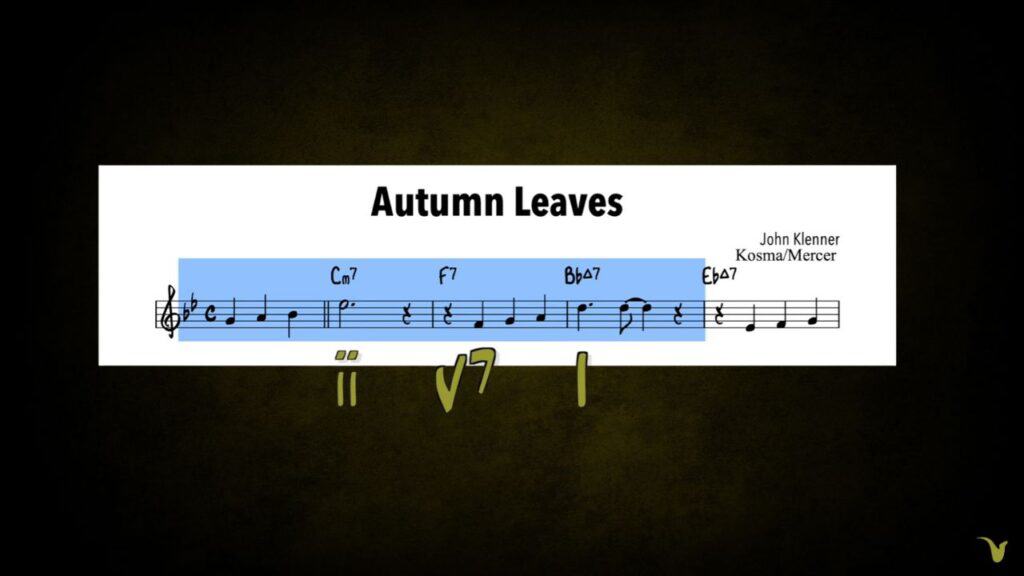
Major ii – V – I
Our first tune is Autumn Leaves and it begins with our most important harmonic building block, the ii – V – I.
The ii – V – I block appears in nearly every jazz standard. So once you can recognize it, you will already know a portion of thousands of songs, including the three we are looking at today.
Same Chord Quality Moving Up a 4th
In Autumn Leaves, we follow our I chord with the IV chord.
Chords of the same quality moving up a fourth is extremely common. Sometimes they will be major 7 chords as we have here. Sometimes they are minor 7s and sometimes they will be dominant 7s. Let’s add it to our master list.

But before we move on, I just want to point out that in our ii – V – I chord progression, each chord also moves up a fourth every time. That interval is extremely important.
Minor ii – V – i
The next four bars of Autumn Leaves contain another must-know harmonic building block: the minor ii – V – i.
The minor ii – V – i is just like a major ii – V – I but in a minor key. The ii is going to be a Am7b5 chord. The V will usually have a b9 and the i chord will be minor.
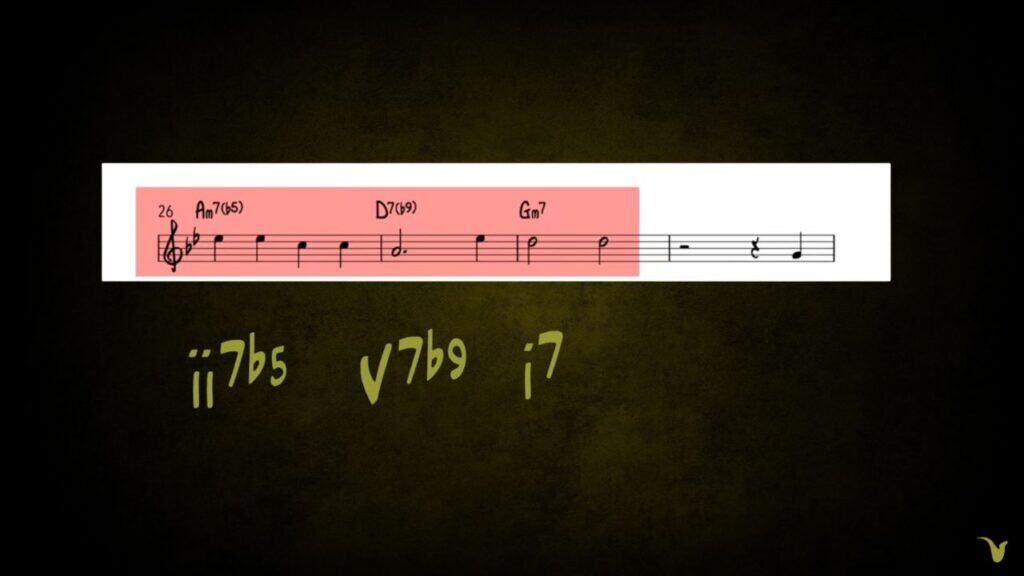
Let’s add it to our list on your PDF download and quickly look at the rest of Autumn Leaves. As you can see, the whole song is made up of just these three patterns.
With only three blocks, we can build a classic must-know jazz standard. And thinking of it this way makes memorizing tunes so much easier. The next jazz song you’ve got to know is There Will Never Be Another You, and you’re in luck because it is built using the same three blocks from Autumn Leaves along with a couple others.
Standard 2 – There Will Never Be Another You
This song is in Eb major and the first chord is the I chord. So we’ll put a big old Roman numeral I right here.
Lots of songs start on the I chord, which can be major or minor. In measures three and four, we already have one of our harmonic building blocks we saw in Autumn Leaves, the minor ii – V – i.
Relative Major and Minor
Notice that this minor ii – V – i is resolving to C minor, which is the relative minor of our home key of Eb major.

This is exactly what happened in Autumn Leaves.

We had a major ii – V – I to Bb major and a minor ii – V – i to its relative minor key of G minor. Modulating between relative major and minor keys is so common. It happens in all three of the tunes we are looking at today as well as thousands of others.
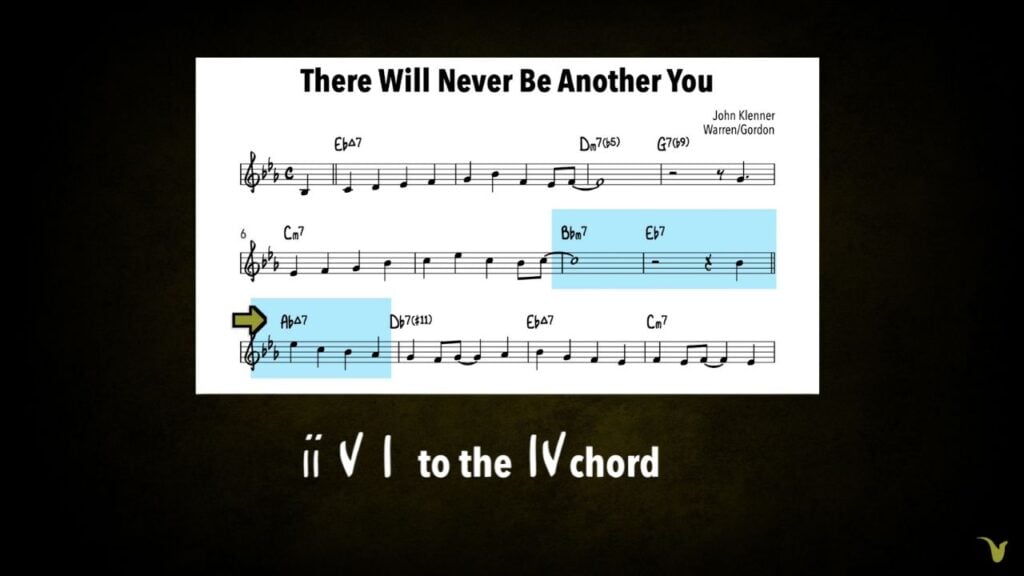
ii – V – I to IV chord
In measures 7 to 8 we have our harmonic building block number one, the trusty ii – V – I. But notice this time it’s going to the IV chord. This is extremely common and you’ll find it in countless songs.
The Backdoor
After our IV chord, we have this Db7#11. This is called the Backdoor.
The most common harmonic progression in all of music is simply V to I. The backdoor is an alternate way to get home. You can recognize the backdoor V chord because it’s a whole step below the root of the home key. Very often the backdoor V chord will have a two chord preceding it.

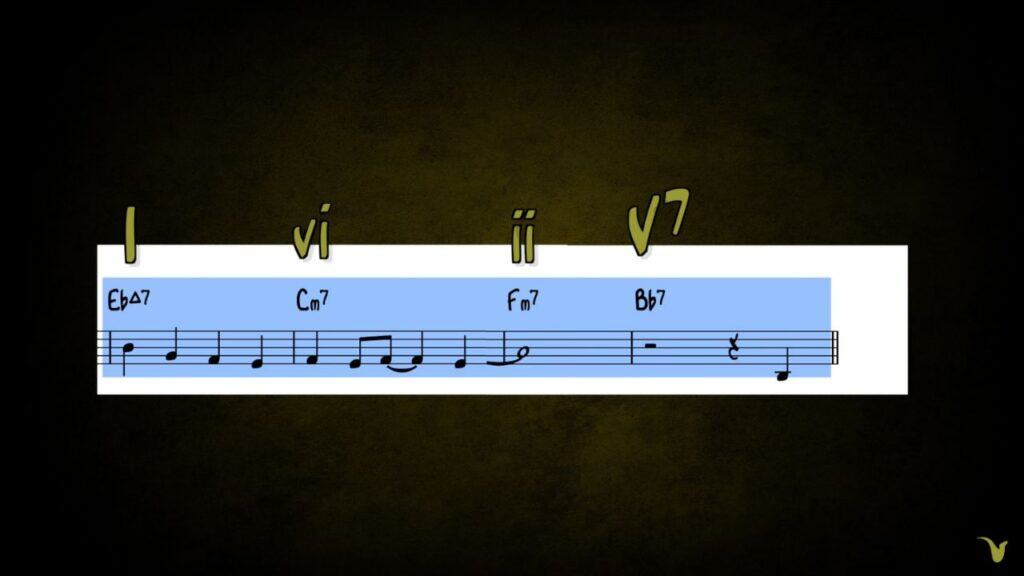
I – vi – ii – V
Now we’re back at the I chord followed by this vi. This is part of a larger harmonic building block that is extremely common: the I – vi – ii – V. It’s very much like our trusty ii – V – I, but with the addition of the vi chord.
Dominant II chord
I love the dominant two chord right here in There Will Never Be Another You. The II chord is not minor, it’s a dominant 7. It gives this sense of anticipation. It’s leading us somewhere on the way home.
The dominant II chord, also known as a secondary dominant, is almost always followed up by our trusty old ii – V – I.

That’s just the first half of the tune. There Will Never Be Another You is a 32-bar form with two 16-bar A sections that are slightly different.
Backdoor #2 (Side Door)
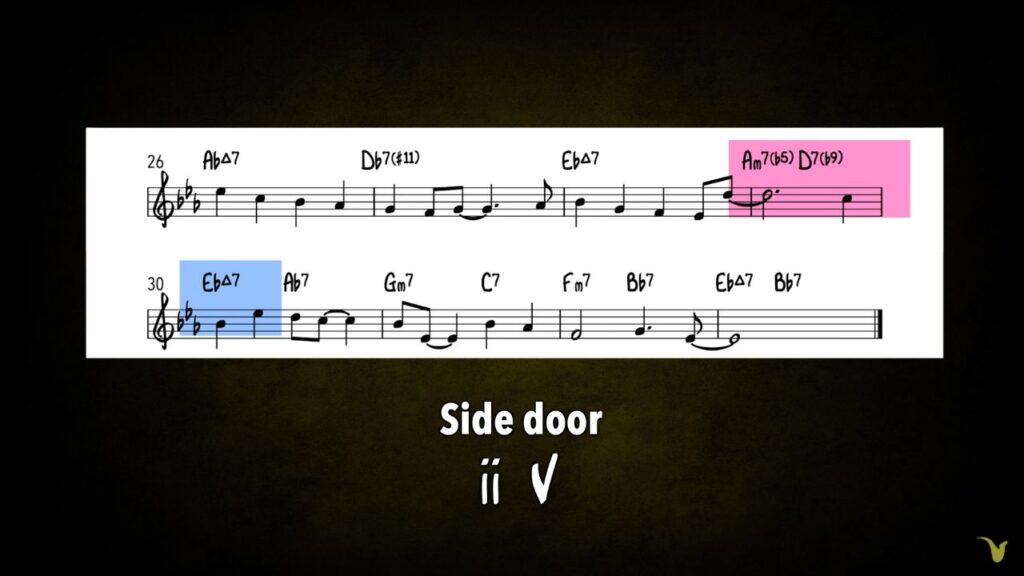
In the second A section, we have one more new harmonic building block. This is sometimes called the second back door, but I like to call it the side door.
Although it often resolves to the minor iii chord, this side door harmonic building block is typically a minor ii – V, but sometimes you’ll see a major version.
So far, we have only nine blocks to learn, but these patterns make up the majority of all the chords in every jazz standard.
Standard 3 – Just Friends
Let’s move on to our third song, Just Friends, which is mostly made up of the harmonic building blocks already on our list, but it does contain two new ones. Let’s find them.
Starting on the IV chord
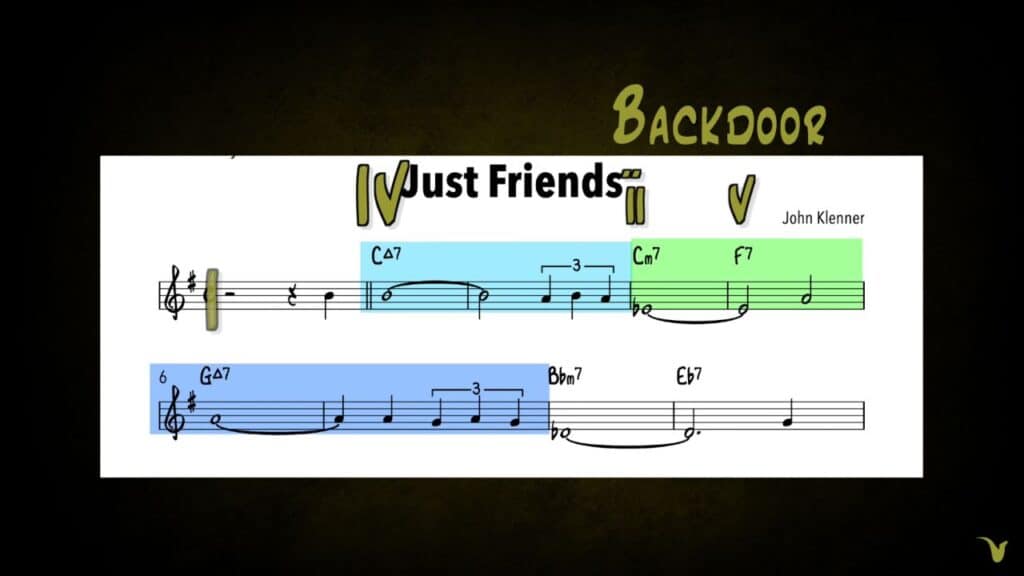
Just Friends begins on the IV chord. Think of the IV chord as the neighbor’s house, the place you drop by all the time and hang out for a little while before eventually coming back home.
When that major IV chord turns minor two bars later, that is a dead giveaway that we are going home from our neighbor’s house through the back door.
ii – V up a Minor 3rd
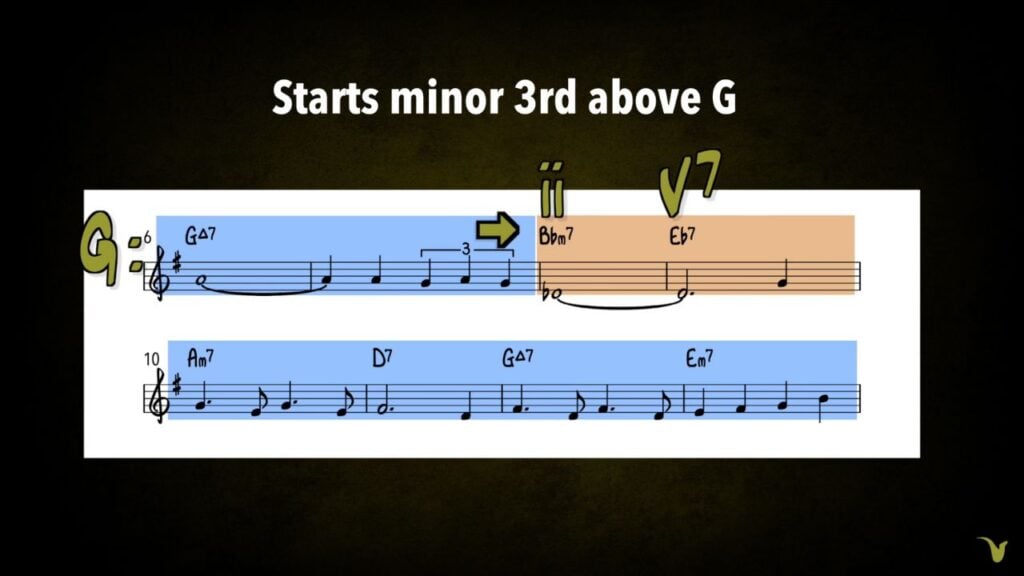
In bars 8 and 9, we have a new harmonic building block that I call the ii – V up a minor 3rd.
It’s a ii – V that starts a minor 3rd above the root of our home key. You can call these things whatever you want. This name helps me identify it and remember what it is.
That’s it for new harmonic building blocks. The rest of the tune is using ones that are already on our list. Let’s just go through and label them.
Now, this list of 11 harmonic building blocks won’t get you through every single jazz standard. There are several more we could add to this list. But already you can see how frequently some of these get used in other songs.
Just with these 11, you’ll be well on your way to knowing the changes to countless jazz standards.
Additional Resources
But what should you practice on your saxophone so that you can weave through these chord changes smoothly and play solos that swing while nailing the chords?
I’ve got a fantastic exercise to help you do just that in this article right here. Go read this blog post next because it’s going to help you put into practice everything I just showed you about the chords. And if you want my help in getting a handle on soloing over jazz standards, click here and we’ll get you playing better than ever.