

What Tim McAllister Taught Us About Practicing — Bridging Classical and Jazz
Tim McAllister is one of the most accomplished classical saxophonists in the world, but spend ten minutes with him and it becomes clear he has a lot of respect and admiration for jazz and its players. He’ll tell you his classical playing is better because of his love of jazz, and that the crossover between the two worlds is extremely prevalent.
We sat down with Tim at the North American Saxophone Alliance 2026 Biennial Conference in Columbus, Ohio to talk about how he practices, how he teaches his students at the University of Michigan, and the specific habits that have shaped his playing for decades. What follows is a breakdown of his practice philosophy — concrete, actionable, and refreshingly free of mystique.
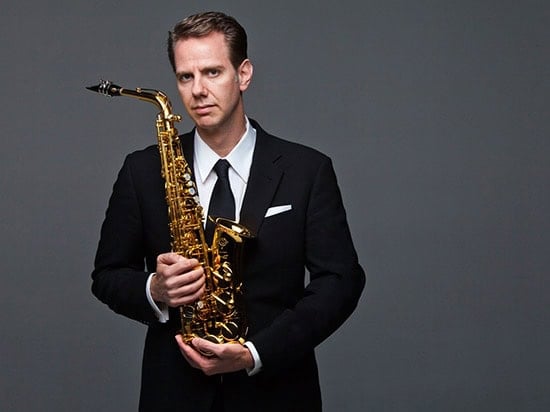
There’s no mystery to becoming a great player
Tim opens with a question he asks every new student on day one: tell me how you practice. The answer almost always reveals what that student needs most. And his core message to all of them is the same — great playing isn’t a secret. The path is well-lit. You just have to be willing to walk it.
A student approached him after a recital and asked how his technique was so clean. His answer was one word: scales. That’s it. No trick, no shortcut. Just the work, done consistently, over decades. Fundamentals and consistency will help you get farther and will benefit your playing as a whole, despite what genre you prefer to play.
Daily Practice Habits
There are a few practice habits that Tim tries to implement into his routine on a daily basis.
1. Long tones (30 to 45 minutes)
Tim explains that long tones need to be a substantial part of your daily practice. The goal is to just sit with your sound. Most students, he says, have never been taught the patience required to be inside their sound. He contributes part of the cause of this problem to band-room culture, teaching students to show up five minutes before rehearsal, slam their horn together, play a tuning note, and start playing band music. The message they internalize is quick assembly, quick playing. Long tones help reverse that conditioning.
2. Overtone work
Tim studied under Donald Sinta, whose approach to overtones went beyond developing the altissimo register. Sinta wanted his students to understand the mechanics of overtones — what the soft tissue is doing, what’s happening in the oral cavity, the concept of voicing- because that knowledge transfers directly to crafting tone. It’s only to your benefit to have a mastery of what’s going on in the oral cavity.
3. Mouthpiece flexibility
Mouthpiece scales and overall flexibility on the mouthpiece. Tim discusses how this daily practice helps him feel more connected to his soft tissue and embouchure.
4. Scales — but learn them by ear first
Yes, students eventually need to read difficult music. But the conventional approach of teaching scales primarily through the page misses something essential. Put on a tuning drone. Work slow scales in unison with the drone. Learn the sound of the scale before you learn the names of the notes or the fingerings.
He’s a deep believer in Jerry Coker patterns and other simple scalar fragments (1-2-3, 1-2-3-4, 2-3-4-5, etc.) drilled in 12 keys. Doing this without reading forces ear-driven learning, and the learning curve for music will be much shorter if you’re ear-driven more than eye-driven.
The Seven-Times Rule
When you’re working on a difficult passage, you have to play it perfectly seven times in a row before you move the metronome up. And “perfectly” doesn’t just mean the right notes and rhythms — it means the color you want, the dynamics you want, the articulations you want, the vibrato you want. Everything.
If you make a mistake on the sixth rep, you start over. If you make a mistake on the seventh rep, you start over.
Why seven? Tim discusses the value of repetition cycles and how proper understanding of this technique can contribute to positive memory imprinting. Most of us under-practice and never imprint properly. Some of us over-practice and hit a saturation point where we stop learning. Seven correct, complete repetitions is the sweet spot for genuine retention — and violinists have understood this for centuries.
The moment you play something wrong, you’ve imprinted that mistake. And it takes far more effort to eliminate a mistake than to learn it correctly from square one. Slow it down. Quarter note equals 10 if that’s what it takes, and play it perfectly before you move the metronome dial up.
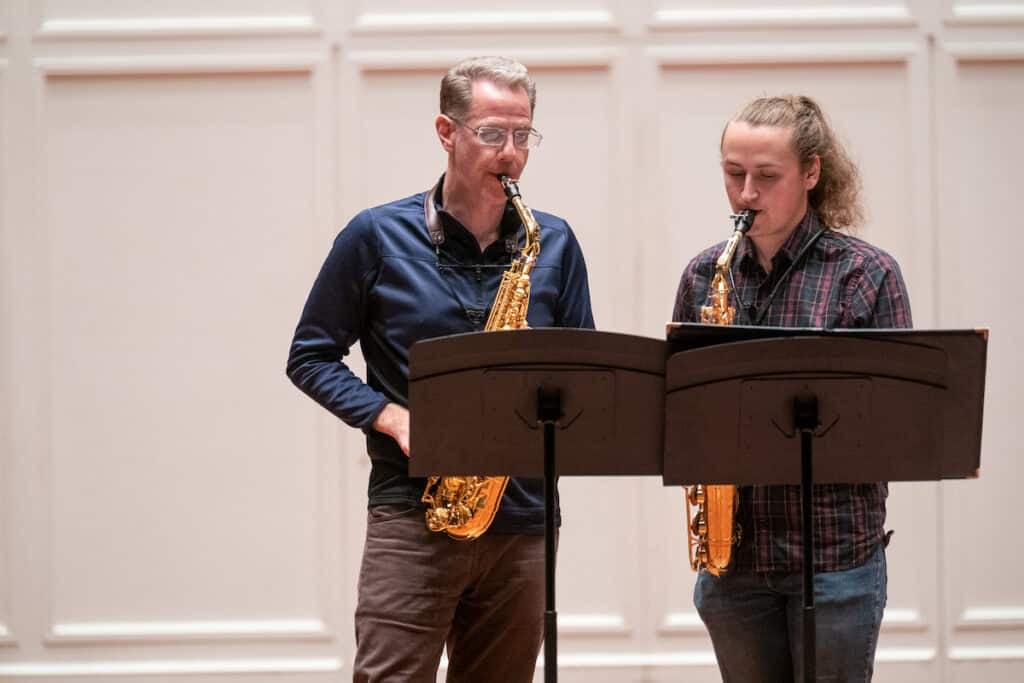
Keep the Brain Alive
Repetition is essential, but Tim is clear that practice can’t be only repetition or it becomes stagnant. Every day, introduce something new. And when something feels boring or stale, challenge yourself to go deeper. If you’re bored with an étude, play it up a half step. The brain wakes up immediately and engages to tackle this new obstacle. Sinta used to joke that if you’re bored with the Creston Sonata, play it up an octave. “That will humble you.”
Work Backwards from the Calendar
If you have a recital, audition, or gig in a month, point at the calendar and build your strategy backwards from the date. With enough lead time, you can use the seven-times rule properly. Without enough lead time, you’re forcing your brain to imprint under stress, which is exactly when mistakes get baked in.
One Step Up the Ladder a Day
The daily question isn’t am I a great player yet? The daily question is is something I’m doing today better than it was yesterday?
That’s the only standard worth holding yourself to. One step up the ladder a day, repeated over years, is what separates the players you admire from everyone else.
Why This Matters for Every Saxophonist
Tim is a classical player, but almost nothing in his practice routine is exclusive to classical playing. Long tones, overtones, mouthpiece flexibility, scales in 12 keys, the seven-times rule, the discipline of slow imprinting — these are universal. They’re what serious jazz players do, and they’re what serious classical players do, because at the level Tim operates at, the two worlds are doing the same things for the same reasons.
Whatever you play, the framework holds: protect your tone work, learn by ear before you learn by page, drill patterns in all 12 keys, imprint correctly with the seven-times rule, and keep the brain challenged.
There’s no mystery. There’s just the work. Want more practice tips? Check out this article here!





1 thought on “I Asked Classical and Jazz Pros What They Practice and Didn’t Expect This”
It still amazes me to read about how much work, practice, time, effort, etc. go into great musicianship (writing, athletic performance, acting….most anything!) We are saturated with presentations of the perfected product. Watching the baseball player stepping to the plate and hitting homeruns, listening to a virtuoso instrumental performance, seeing a biopic movie that starts with the star appearing before 1000s and playing at a world class level. We too rarely see the countless hours and years of dedicated practice that proceed the accomplished performance, so we think it just seems to happen if you have sufficient talent.
As they say, talent is nothing without hard work. (Although hard work divorced from talent doesn’t get too far up the hill either!)