
⭐️ Access Our Free Sax Lesson Downloads
7 Levels of Jazz Sax Improvisation
I’ve never met a saxophone player who didn’t want to know how to improvise. But I’ve met many that never even try because they don’t know where to begin.
If you want to free yourself from sheet music and finally be able to play improvised solos, you just need a clear plan. So, in this video, I’ll tell you exactly what you need to know and practice in order to start improvising solos that sound great in any style of music.
Even though there is an order to these levels, everything in this video is something you will practice and work on daily for as long as you play your instrument. We never complete the study of any of these things.
So rather than approaching this as a checklist of things you need to complete, consider this a list of areas where you want to be constantly improving. I literally work on every one of these things just about every day and will continue to do so for the rest of my life. I also have free video lessons and PDFs for every level in this video, available through the BetterSax Shed.
Level 1- Saxophone Sound
Why did you start playing the saxophone in the first place? You didn’t hear someone honking away like a distressed penguin and decide to go buy a saxophone. No, you heard someone with a beautiful sound, and that is what sealed the deal. Nothing else on this list or any list matters if you don’t have a beautiful sound.
Luckily, it’s easy to maintain a good saxophone sound. All you have to do is be consistent about playing every day. Spend 5 to 10 minutes focusing on your sound as a warm-up and you’ll be good to go.
Over the years, I’ve made a bunch of videos with exercises on sound and embouchure. And if you’re subscribed to the channel, you’ll see them come up in your suggested videos.
Here’s a pro tip that will go a long way. Everything you play should be considered a sound exercise. scales, arpeggios, patterns, licks, song melodies, and even improvised solos. Always play with your best sound, no matter what you’re doing on the saxophone.
Now, in level two, we’re going to nail down the second thing you need to focus on for every note you play.
Level 2- Jazz Improv Rhythm and Scales
Scales are where a lot of people go wrong when it comes to improvising. We need scales just like we need the alphabet for a written language. But just like we need to turn the alphabet into words, we need to turn scales into musical phrases before they become useful.
The good news is you really only need three scales to improvise in any style of music, and one of those is much more important than the other two.
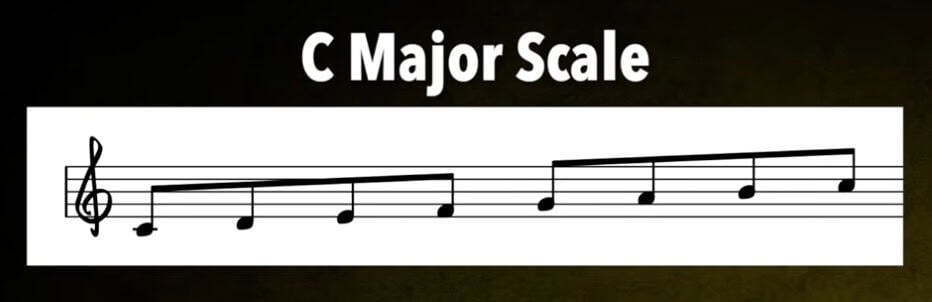
Focus your time on learning the major scale really well with a plan to get it down in all 12 keys eventually. When I was in high school, my teacher gave me an exercise that I worked on a little bit every day until I could play all my major scales in one breath.
The reason that the major scale alphabet is so important is because it allows you to spell the words that communicate just about anything you want to say musically. The other two scales that give the most bang for your buck in terms of vocabulary are going to be the pentatonic and harmonic minor scales.
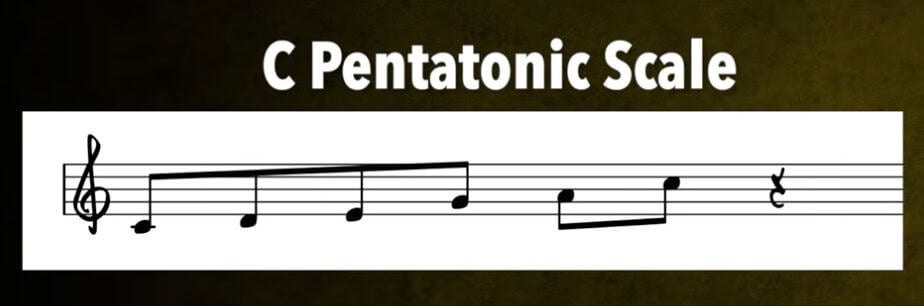
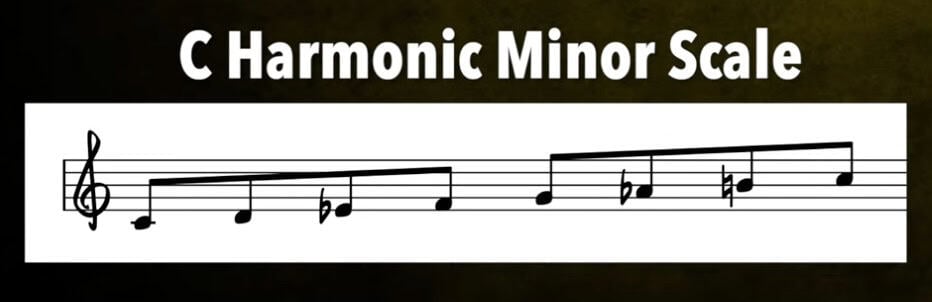
Use your scale practice to simultaneously develop your rhythm. Rhythm is the number one weakness I hear in most saxophone players. Compare it to driving a car. If you hit your brakes a little too late or turn a little too early, you’re probably going to crash. And while no one’s going to die if your musical rhythm is off, playing with rhythmic accuracy goes further than just about anything else towards making you sound good.
So practicing with the metronome is not an option, it’s a requirement. Same deal as when I said make everything you play a sound exercise. If you make everything you play on your saxophone an exercise in rhythm, you will improve so much faster than 99% of others.
But scales are only half the story. If we really want to learn to improvise, we need to get what’s in level three under our fingers.
Level 3- The importance of Triads and 7th Chords in Improvisation
I find that most students spend a lot of time working on their scales, but not nearly enough attention gets paid to playing triads and seventh chords. If scales are our alphabet, then chords are our words.
We make chords by taking every other note in a scale. The simplest form of a chord is what we call a triad, and it has three notes.
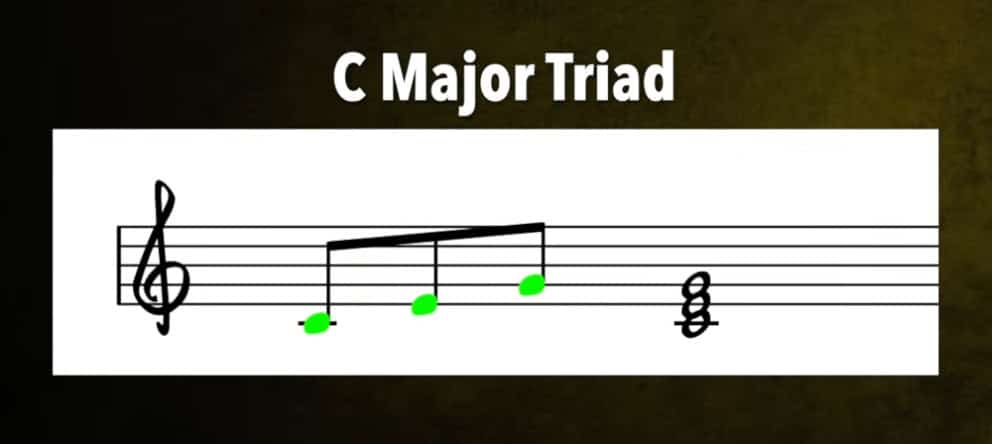
There are four types of triads, but only three of them can be found in our major scale alphabet. We have three major triads, three minor triads, and one diminished triad in there.
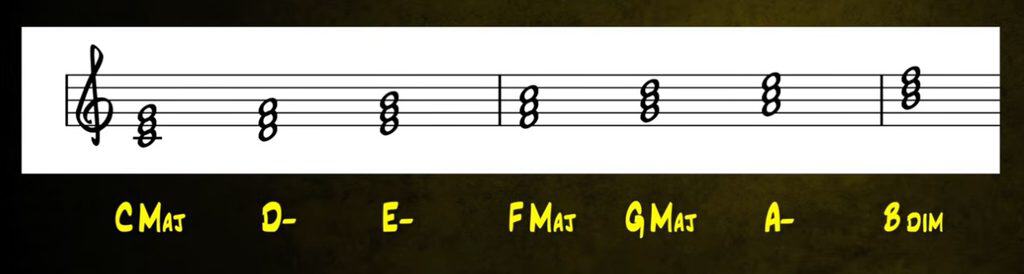
A seventh chord is when you add another note on top of our triad. Our major scale alphabet gives us four different types of seventh chords. We have two major 7 chords, three minor 7 chords, one dominant seven chord, and one minor 7 flat 5 chord, otherwise known as half diminished.
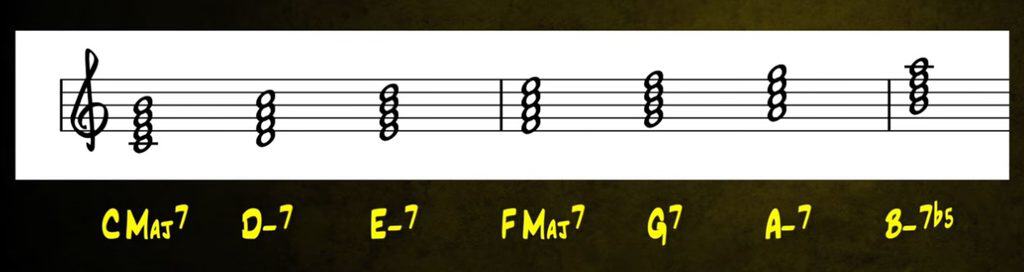
While you absolutely need your alphabet, the scales, chords are more useful musically. Don’t neglect practicing triads and seventh chords. A great starting point is just playing the diatonic triads found in a major scale up and down in all 12 keys.
Level 4- Studying Jazz Chord Progressions
Far too many saxophone players focus on just the sound, scale, and arpeggio exercises at the expense of learning songs. And for each song, we have two parts to learn. The melody and the chord progression.
If individual chords are words, then we could think of chord progressions as grammar. Just like with word order in a language, we have repeated patterns of chord order in music. In the same way that you need to know an adjective typically comes before the noun, in music, the five chord typically comes before the one chord.
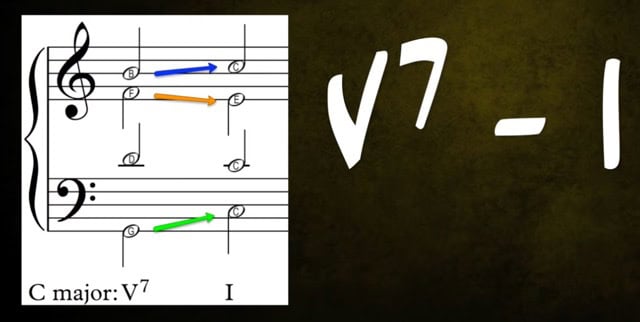
The good news is that there are nowhere near as many chord patterns in music as there are grammar rules in a language. In fact, there are whole genres of music that only use a handful. Even in jazz, which can get quite harmonically complex, there is an enormous amount of pattern repetition when it comes to chord progressions.
I made a whole video about how you can break down most jazz standards into fewer than 10 harmonic building blocks and most tunes only use three or four. You’ll find it in the BetterSax shed along with the PDF download.
Chord progressions like the 251 and a 12 bar blues are great starting points and you’re going to want to gradually add chord progression patterns to your knowledge of our musical grammar. And the best way to do that is by studying the next level in our list.
Level 5- Learning new Jazz Songs and Melodies
How many songs do you know? If you play a gig, go to a jam session, or even sit in with a band, you’re expected to know some songs. But the truth is, most saxophone players know very few or none.
Playing songs is the ultimate end goal of all this practice. So, it’s very important that we spend time each day working on them. This means first learning the melody of a tune.
If you want to get good at improvising, you need to start by memorizing song melodies. If you can’t play the melody without looking at the sheet music, how are you ever going to improvise a solo? So, if you’re someone who needs the sheet music to play anything, think of song melodies as your way to wean yourself off that crutch.
Many saxophone players think that once they have the melody learned, they know a song. But that’s not actually the case. Songs have a chord progression supporting that melody. And we are just as responsible for knowing those chords as piano players, guitar players, and bass players are.
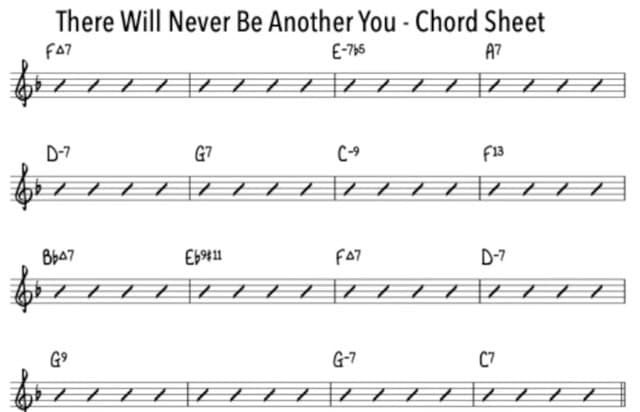
The chords are what determine how we tell our improvised story. In addition to practicing your song melodies, you want to practice playing your scales and chords over the progression, always with your best sound and best rhythm in mind.
This is where a lot of people stop, but the next two levels are what separates strong improvisers from the rest.
Level 6- Jazz Sax Licks and Vocabulary
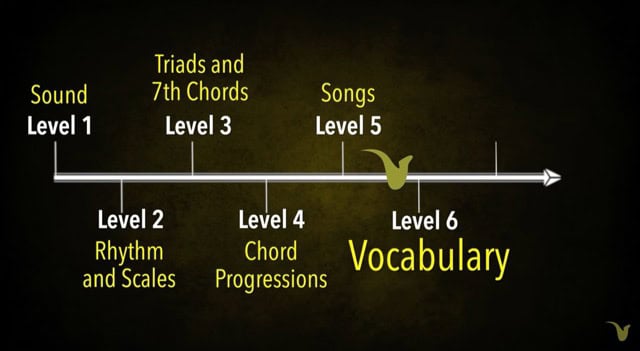
The word improvisation is very misleading. Most of what gets played in good improvised solos is not actually made up spontaneously on the spot.
Besides all the musical structure like scales, chords, rhythm, chord progressions, and songs that we’ve already talked about, good improvisation also has idioms and commonly used phrases just like a spoken language.
In music, we call these licks or vocabulary. The art of improvisation is based on a tradition that gets passed on from musician to musician across generations through recordings and live performances. If I were to just make up verbal expressions that no one had ever heard before, it would sound weird.
Like if I told you, why make a whole cheese out of this? It’s actually fingers in the nose. That actually means something in French. But in English, it’s gibberish. If you want to sound fluent in a spoken language, you’ll want to sprinkle some expressions into your conversations. The exact same thing goes for music.
Audiences want something familiar to latch on to. Improvising doesn’t mean making up new material all the time. It’s actually much easier than that. All you have to do is build up a small collection of familiar phrases you know how to play in context while soloing.
But you don’t need to rely on me or anyone else to get your vocabulary in phrases. In fact, it’s better if you go find them on your own. And that’s what we’re going to learn to do in the next level.
Level 7- Jazz Listening and Transcription
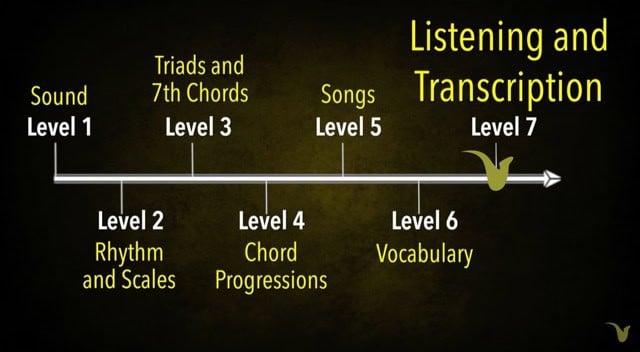
If you want to really understand a language, you have to do a lot of reading. Music is no different. And to become a competent improviser, you’ve got to do a lot of listening. But listening alone is not enough.
A critical part of the jazz tradition is learning other players solos note for note. It’s just like hearing a spoken language. You have to copy and mimic the sounds you hear as best you can. Otherwise, you’ll never sound like a native speaker. You’ll always have a heavy accent when playing.
Everyone can transcribe, but most people think it’s easier to try to find the sheet music to whatever they want to play. Let me give you my best explanation as to why that’s holding you back.
Improvisation requires us to come up with a musical idea in our head and then play it on our instrument. We literally have to transcribe what we’re hearing in our mind in real time. So transcribing and copying what you hear other people play is your best preparation for playing great improvised solos.
Start with something relatively easy that speaks to you. Pick the thing that made you want to start playing saxophone or music in the first place. Once you learn it and can recreate it on your instrument, you gain ownership of that music. It becomes part of you in a new way. And that’s where the magic happens.
Now, you might be thinking, “That’s a lot of stuff to learn. If only I had a practice plan with exactly what I needed to do each day written out for me.”
Well, you’re in luck because I created a 30-day practice challenge with daily lessons laid out for you. I walk you through exactly what to work on across all seven of these levels. And by the end, you will have learned four songs and how to improvise solos over their chord progressions. So, go watch this video next to get started because you’re only 30 days away from massive saxophone progress.



1 thought on “Everything You Need to Know for Sax Soloing (In Order)”
Dear Jay
Many thanks for all your emails and video I watch most of them with interest. I am a 80 year old self taught (mainly ) late starter I spent 22 years in the British Army and promised myself when I left I would buy a sax and learn how to play in and learn how to read music.
Luckily an old sax player advised me to Buy a Clarinet and if that worked out I would fine the Sax easy to play. Over time I brought a 1924 Selmer model 22 Alto, A new Selmer series 2 Tenor in 1997, and a beautiful Yamaha Bari, and a cheap straight Soprano. In 1994 my 7 yo Grandson ask me to teach him I gave him my Clarinet to start with, then at 10 I gor him an Alto.
By the time he was 15 he was a grade 8 on both instruments passing with a Merit and Distinction on Sax way pass me as a musician. We both played in an 18 Piece Jazz Band ie Miller/Elington/Basie for 8years.
In recent years I have had Heart problems ( a double By Pass in 2025 ) and a loss of many upper teeth and a denture which has altererd my embroucer .
I would have loved to enrol with Better Sax 20 years ago, but now its a bit late. I play most days on Alto and Tenor the other two I sold a couple of years ago. I still have the 22 , but I brought a Better Sax Alto a few years ago and I am most impressed with it . It was the best £750 I have ever spent. keep the got work up you are a great Player / Tutor
Yours Neil