

Start the Challenge as a BetterSax Member
30 Day Practice Plan
As a student I used to think that if I just found the right book or had a lesson with the right teacher, everything would suddenly click. But after decades of studying and teaching, I’ve learned what actually works is consistency, variety and having a clear plan. So in this blog, I’m going to show you the exact timeline for how 30 days of structured practice can set you up for a lifetime of steady improvement and help you finally playing songs and improvising solos you’re proud of.
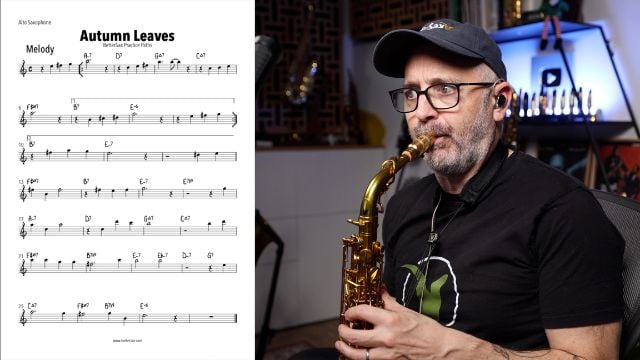
Day 1 Learn the Melody
You have to begin with your mindset. From day 1 it’s important to understand that you have 2 very simple goals for each day.
Goal 1 is to just get your saxophone out and practice for a minimum of 15 minutes. That’s doable right? You’re free to play for longer if you wish, but that initial commitment is manageable even on your busiest days.
Goal 2 is to move one baby step closer to your target by introducing something new each day. Let’s say your target is to learn a song and be able to improvise over the chord changes. Day 1, you’re just going to learn the melody and spend at least 15 solid minutes practicing it
You probably won’t get it perfect and that doesn’t matter, you got the horn out, took your baby step and introduced something new. Every day that you do those things you are going to improve and feel good about it.
Day 2 Learning The Chord Progression
Today you are going to learn the chord progression of your song so you might play something as simple as the roots of the chords in rhythm. Or maybe you play simple triads of the chords over the form.
You spend 15 minutes on this and then put the horn away or keep practicing, whatever you want. 2 days in a row is already a streak, and it feels good to have learned some new material.
Day 3 Develop Finger Technique
Today you are going to develop your finger technique a bit, so practice arpeggios over the chord changes. It’s a little challenging so slow everything down to a tempo that is manageable.
After 15 minutes of this you are feeling like you made some solid progress. You are really getting to know the chords to this song, your fingers are warmed up, and your sound is improving from the daily practice.
Day 4 Improvisation
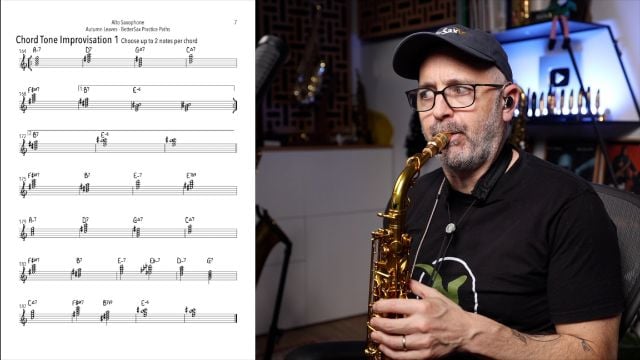
Today you are going to spend your practice time on improvisation. Not random noodling, but applying a very specific restriction on what you are allowed to play over the song you are learning.
For each chord, you can only use 2 chord tones to improvise with. Limiting the number of notes you can use makes it challenging, but also creates a situation where you are forced to be more creative rhythmically while making it impossible to over play.
In all the years you’ve been playing saxophone you rarely managed to be so consistent and never introduced new material on a daily basis like this.
You’re finding it really rewarding to get these little wins each day. Your personal expectations are managed by the easy to do, 15 minute minimum, and you’re already looking forward to tomorrow.
Day 5 Continuing Improvisation
Yesterday’s session was great. Today you’ll be improvising over your song again, but this time you are allowed to play any of the 4 chord tones. It’s still a limitation that keeps you in check but compared to the 2 note limit you feel a new level of freedom.
It’s amazing what you can do with some structure and a solid plan. 15 minutes turned into a 90 minute session, and you would have played longer if you didn’t have to go make dinner.
Day 6 Apply a Lick to the Chords
Today you want to get some authentic vocabulary into your playing, so you take a lick from a book or a YouTube video or recording you love and apply it to the chords of the song.
First you plan out where it fits nicely in the chord progression and then you spend your 15 minutes dropping that phrase in repeatedly everywhere it can fit. We are what we repeatedly do. If you want anything to come through naturally in your playing you need to repeat it, way more than you think is necessary.
Day 7 Recapping your Progress
This week you feel like you’ve made more progress than you have in years. You are beginning to realize that it’s not so much about how many hours you put in on the horn, but more about how consistent you are and how fresh the practicing feels each day.
And science backs this up. Practicing 15 minutes per day for 7 days will get you better results than practicing for 2 hours all at once even though it’s less total time. Researchers call this the spacing effect.
Today, your goal is to recap everything you touched on this week so you spend a few minutes recalling the song melody, then you improvise over the chords but with purpose. No more noodling, instead you are outlining chords, connecting the harmony, quoting vocabulary, leaving space and playing with solid rhythm.
This one week of focused practice with a clear plan has allowed you to really learn a song properly. Something you’ve never actually done before.
Now you can play the melody from memory, improvise a solo that may be simple, but sounds so much better than your random noodling ever did.
What’s even more exciting though is that you’ve had a taste of what is possible with this new approach.
Imagine how much better you’ll be in a month, or a year of this.
That’s why I created my 30-Day Jazz Standards Challenge inside the BetterSax membership. Instead of overwhelming you with a mountain of lessons, I guide you through a short, manageable lesson each day. Something you can do in just 15 minutes. The next lesson will be waiting for you the following day so you always have a clear path to follow.
No guessing. By the end, you will know how to play 4 of the most popular jazz standards and improvise solos that sound great over them.

Day 8-14 It’s Time to Move onto a New Song
Even though you know there’s a lot more you can do with that first song, it’s time to move on to a new one. The thing that’s propelling you forward is the variety and freshness of the material.
And there’s research behind why this works better than practicing the same stuff day after day. When you switch things up daily, it feels harder in the moment but you retain far more of it. Scientists call it the contextual interference effect. Each day this week you follow the same format.
Focus on just one thing at a time. Melody, chord progression, triads, scales, patterns, language, transcription. By the end of the week, you’ve learned another song and can solo over it. You’ve never felt so much progress in such a short window. This practice doesn’t feel like work at all. It’s fun and you’re looking forward to each session.
Day 15-21 Don’t Give Up
Somewhere around here, you will have a terrible practice session. Everything will feel as though you have gone backwards. Your reed will be fighting you, your saxophone will be fighting you, your fingers won’t move the way they did the day before.
It’s frustrating and when your 15 minutes are up, you feel so disappointed that you want to give up right there and then. What’s the point of practicing every day if you actually get worse?
Well, you haven’t actually gotten worse, your ears have gotten better and your expectations have risen. This is the critical moment everyone faces.
It will happen to you and when it does, put your horn away with a smile on your face because tomorrow will likely be the best practice session you’ve had in a long time.
This is why consistency always gets results. Most people give up as soon as something feels a bit too difficult or challenging.
But, in music, the most difficult days almost always come right before a major breakthrough.
Day 22 Keep your Streak Going
Yesterday felt awful. Everything you played sounded terrible and getting the horn out of its case today feels particularly difficult. But, you’ve been so consistent for 3 weeks now and want to keep your streak going. Besides it’s only 15 minutes you have to suffer through.
You start playing but something feels different today. Your sound is ringing with a gorgeous tone you’ve never achieved before. Your rhythm is in the pocket and your fingers are moving around the keys effortlessly. The new exercise of the day comes easier to you than ever before.
You can remember the chord progression and melody without looking at the music. You can’t help but wonder what happened. How could your playing seem to change so much from one day to the next?
Here’s what happened. While you slept, your brain was consolidating everything you struggled through in the days before. Researchers have found that motor skills keep improving after your practice sessions while you sleep. They call it memory consolidation.
You can remember the chord progression and melody without looking at the music.
Day 23-29 Understanding the Journey
You are on your 4th new song in as many weeks. By now, you have established a full on practice habit that you plan to keep. The consistent improvement feeds your desire to get the horn out each day and creates a loop.
If you miss a day, something feels off. You’ve begun to understand that the journey is not about perfecting one skill at a time before moving on. The thing that gets you into the practice room each day is the new challenge and the feeling of steady progress.
Day 30 Cycling Back
You’re playing better than you ever have in your life. You know exactly what approach gets you the best results and are motivated to keep going.
At this point you can cycle back to the songs you’ve already learned or keep adding in new ones. When you eventually cycle back to material you worked on previously, 2 important things happen. You realize how far you’ve progressed since the last time you practiced it, and you understand the concept at a deeper level.
In order for that to happen though, we need there to be enough time in between. The more you cycle through this process the faster you progress.
Your Journey has Just Begun
That first 30 day practice challenge is just the beginning. It’s where you establish a strong practice habit and learn what actually works.
Your journey has just begun, but now you’re on the fast track. And if you want to save even more time, go read this next article where I tell you the only 3 scales you need to practice for the vast majority of music you’ll ever play.





1 thought on “Practice Saxophone Like This for 30 Days (You’ll Never Play the Same)”
Your suggestions of how to learn new tunes are great. I wish someone had told me that system many years ago. Now I’m going to tell you something that happened to me that after many years was a surprise breakthrough. I probably did not become a professional musician because my ‘ear’ was terrible. (No one told me that an ‘ear’ can be trained without too much angst. After playing saxophone, clarinet, and flute for decades (and always being a reader of music with variations on the melody when soloing), I took trumpet lessons for a year from a friend who plays trumpet and saxophone. In fact I gave him his first sax lesson before he went to music school.
It was an interesting experience (learning trumpet.) I continued playing trumpet after that, although I never really got good at it. One night at big band rehearsal (I played lead tenor. My soloing got a little better over the years.)- this particular night, when soloing, I thought after I soloed, Did THAT come from me? And my fellow band members were giving me congratulations. It was not a one-off thing. I had finally achieved excellent relative pitch. And it continued, to the extent that I prefer to play by ear. Obviously, in a big band, you have to read your part. But when soloing, I prefer to play by ear. The only question I had was, how did this happen? After some introspection, I realized it was due to learning how to play the trumpet! After all, playing a brass instrument requires one to pre-hear the note, so as not to play the wrong harmonic. It’s the only explanation that made sense to me. There are, I’m sure, other methods of ear training, and they may well take less time, but I just thank my lucky stars for eventually getting decent relative pitch. When fellow musicians ask me how to attain good relative pitch, I recommend they learn a brass instrument. Any one will do, since the same principle applies.