⭐️ Get the Free PDF from this video Plus our entire BetterSax Shed Lesson Library
3 Easy Jazz Improvisation Exercises
Most jazz exercises are too complex and intimidating for new improvisers.
But there’s a fun way to practice that’s actually easy, even if you’ve never soloed before. I’m going to give you three exercises that build your technique and get you playing solos that actually sound like jazz. Click here to download a free PDF download with all of these exercises written out.
Jazz Improvisation Exercise #1 Major Scale (but hip)
You already know how to practice your major scales up and down.

There’s nothing wrong with that. But in real music, melodic lines are a lot more interesting. If you only ever play your scales going up and down that way, your solos will sound very square.
In jazz, we embellish melodic lines by enclosing target notes with upper and lower neighbor tones.
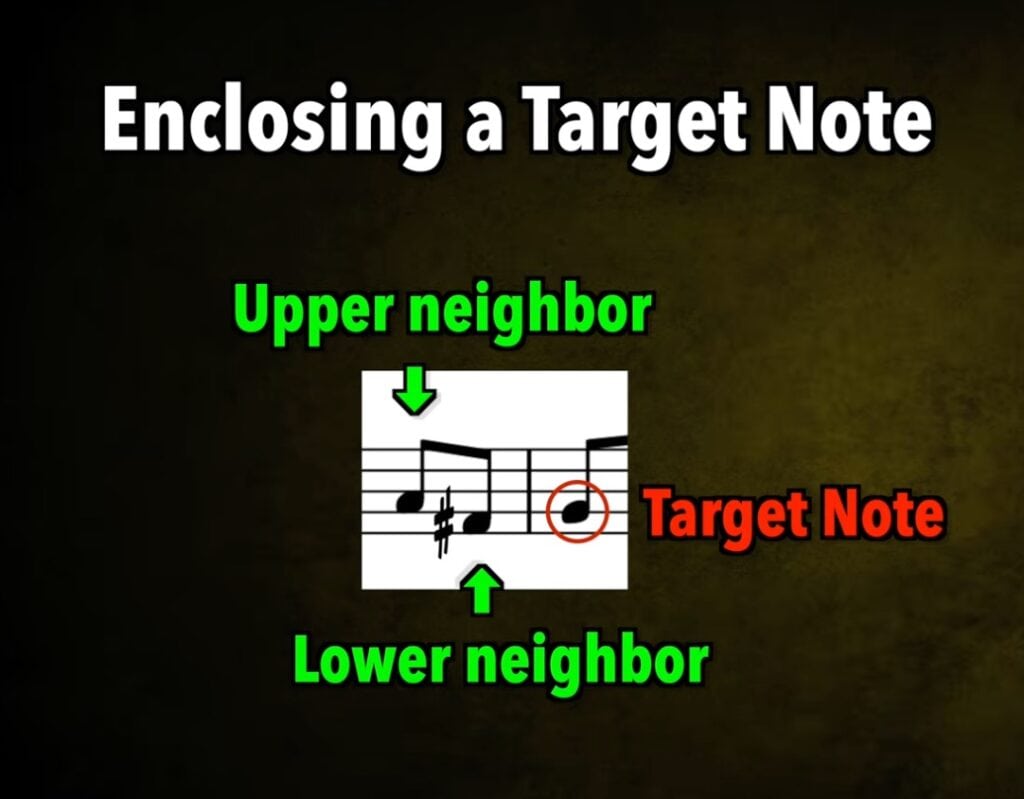
By stacking a lot of embellishments together, you can make a simple scale or arpeggio sound much more complex and hip like this. But that’s obviously much too advanced for this blog.
Here’s your first baby step towards playing lines that sound like jazz.
Exercise number one is just your major scale with an enclosure on the first and last notes like this. All we did was take our plain old major scale and add an enclosure targeting the first note or the root of the scale and another one targeting the last note. It’s a very simple change that’s easy to do, but it instantly makes that major scale sound way more interesting.

Playing your scales this way is also a lot of fun. And I like to just loop them around. Start practicing your major scales like that and you’ll be doing real preparation for better improvised solos in any style of music while also getting your scales under your fingers. On the PDF, this exercise is written out in all 12 keys.
I want you to work towards memorizing this exercise in all the keys because once you do that, you will have reached the first major checkpoint on the path to being able to improvise solos that sound great. But jazz is not just about scales. Next, I’ll show you how the most basic triad can punch way above its weight.
Jazz Improvisation Exercise #2 Major Triad (but hip)
I really wish someone told me how important ordinary triads were when I started learning jazz. A triad is the simplest type of chord. For example, C E G is a major chord or major triad.
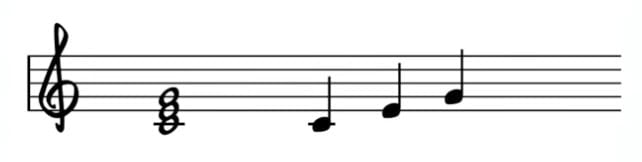
When I was first learning jazz, we seemed to skip straight to seventh chords, which are also very important, but it was a while before I realized how much my favorite players leaned on simple three note chords.
You may have already practiced a major triad the old-fashioned way, like this.

And there’s nothing wrong with that, but it can quickly sound predictable.
For exercise two, we’re simply going to spice up our root note with a lower neighbor like this.

This makes a nice pattern we can loop around as we did with exercise one. You can even stretch this exercise over two octaves if you’re feeling adventurous. You can even combine exercises one and two for a nice longer line.
You can already see with these two very basic exercises how we can transform plain old major scales and arpeggios into lines that actually sound like jazz.
But this next exercise will not only help improve your playing. It’ll show you how some of the world’s most popular melodies are built using these exact same techniques.
Jazz Improvisation Exercise #3 Minor Triad (but hip)
So far, you’ve applied an enclosure to your major scale and a lower neighbor to your major triad. Exercise three is going to make our minor triad sound hip.

The first four notes of Careless Whisper, are a minor triad with an added upper neighbor to the first note. That’s the other half of the enclosure you already know. We can loop this exercise around as well.
Playing basic scales and arpeggios with these simple alterations is an extremely effective way to improve your ability to improvise solos. But you might be thinking, “What about all the other scales in jazz? Don’t I have to know way more than just the major scale?”
Believe it or not, there are only three scales you really need to know for the vast majority of improvising in any style of music. So, go watch this video next where I explain what those scales are and exactly how to practice them so that you can learn to play killer solos that sound great.